The following is lazily adapted from a presentation that I did for my JBU Honors Capstone. It was given to a non-technical audience.
You might not feel this way, but for a software engineer like me…
AI is pretty great.
Indeed, software engineering has been one of the first and most impressive use cases for AI systems, and the tooling to integrate LLMs into the software engineering workflow was developed very quickly after the release of ChatGPT in 2022. Now, the most popular code editing software products on the market delegate tasks to a swarm of AI agents. They can read and write code and other files, run commands on your operating system, and write documentation, to name just a few of their capabilities.
Getting answers to questions faster is another huge benefit. So often when you’re writing code, you encounter road blocks, and the problem is not because you’re a bad software engineer, it’s just you’re not familiar with the particular library that you’re using. Maybe you’re familiar with the syntax of the language you’re writing in. With AI, you can type your question into the chatbot built into your code editor, and get a perfectly formatted answer in a few seconds.
These new tools enable superhuman speed and productivity, and the underlying models are still improving. All this works together to form an enticing pitch. What engineer would decline such a powerful aid to their work?
While I am enjoying the benefits of AI technology, many others fear it. So much economic and social change is coming. Trust me, I know the feeling of wondering what my profession is going to look like in 2-3 years. The future of entry-level software engineering jobs as we know them is bleak. But as a Christian, here’s what I know: AI is not a surprise to God. God placed the latent potential for AI in creation from the very beginning. After all, the deep neural networks that lie at the foundation of AI architecture are inspired by human brains. Just like every other technology, everything from nuclear fusion and fission all the way back to fire, the potential for that technology existed in creation. God put it there on purpose. So, God intended for us to make the discovery of AI. I think we would be remiss to totally reject the capability it offers us. My life and career, potentially, will involve putting AI to work in creative ways for the good of his kingdom.
But even as I get really excited about everything that AI will be able to do for us and enable us to do, I have to be careful to avoid a belief that so much of Silicon Valley tends to believe: technicism. It’s the belief that tech can fix everything; that every problem that humanity has ever encountered will ultimately be solved by the invention and use of technology. But it only takes a quick look at history to see how wrong we’ve been about that. Consider the the inventor of dynamite, Alfred Nobel. He believed that “My dynamite will sooner lead to peace than a thousand world conventions.”1 Even the inventor of the atomic bomb, J. Robert Oppenheimer, had this to say about his creation: “The only unique end can be a world that is united, and a world in which war will not occur.” 2 They both went on the record and said that they bet that their technology would end wars.
So much for that.
Tech enables incredible things. All the statistics say that human health and comfort, life expectancy, wealth have been dramatically increased because of technology and its proliferation.3 But none of those gifts can’t actually fix what’s truly broken with the world: the human heart. A quick look at scripture tells us this. Jeremiah 17:9 says:
The heart is deceitful above all things, and desperately sick.4
And in Romans 8:7, Paul writes,
For the mind that is set on the flesh is hostile to God, for it does not submit to God’s law; indeed, it cannot.
Technology is a powerful thing. It’s so easy for us to place the gifts that it offers in the place of God in our hearts. These are good things, by the way. Health, comfort, and even power5 are things we were intended to have. What’s the problem, then? As Christians we know that we were made to worship God. So, if we try to replace Him, that object of our proper worship, with anything else in creation, we’re going to be left unsatisfied.
It’s so easy to believe that you’re powerful enough to fix problems. As an engineer, it can get wrapped up in your identity that “I’m the problem solver.” But not every problem can be solved with technology. Only Christ can restore our broken human hearts. Only he can take our heart of stone and replace it with a heart of flesh, a heart directed in worship to God.
Let’s return to AI one more time. What’s the Christian approach to AI? I don’t have time in this presentation to develop an entire theology of AI, but I do think a good baseline principle is this:
AI will never be wise.
OpenAI released GPT-3.5 in 2022. It was their most advanced model at the time. To measure its intelligence, they tested its performance on academic and professional exams, fully simulating the conditions and scoring of the real exam. Let’s look at the results6:
| Test | GPT-3.5 | GPT-4 |
|---|---|---|
| Bar | 10th Percentile | 90th Percentile |
| LSAT | 40th Percentile | 88th Percentile |
| GRE Quantitative | 25th Percentile | 88th Percentile |
| GRE Writing | 63rd Percentile | 99th Percentile |
| AP Calculus | 1 | 4 |
| AP Chemistry | 2 | 4 |
GPT-3.5 did not do well on most of these tests. However, GPT-4 is scoring nearly perfectly on all of them. It was clear that these tests were starting to get saturated. The AI was just too good and these tests were no longer providing a meaningful benchmark for AI improvement.
If AI development stopped at GPT-4-level capability, then humans would not have too much to fear about being replaced. After all, an exceptional human could conceivably perform as well as it did on these academic tests. However, AI development is ongoing. So, we needed new tests to measure their improvement.
There are a lot of benchmarks that measure AI models’ competency in various domains, with software engineering being a prime example. Allow me to use one lab as an example: Scale AI. They produced a test with an ominous-sounding name: “Humanity’s Last Exam.”. According to their website, the test consists of
2,500 of the toughest subject-diverse multimodal questions designed to be the last academic exam of its kind for AI.
The best performing models right now are Google’s Gemini 3.5 Pro model and OpenAI’s GPT-5.4 model, both achieving about a 45% on the test.
I make mention of all this just to say, AI is getting really good. It’s conceivable that in the next few years at the rate AI is going, that AI will pass Humanity’s Last Exam, the final frontier of human knowledge. It’s accurate to say that AI will become the embodiment of all human wisdom. Once that happens, will AI be wise?
The answer is no. We can see this directly from scripture. Take Job 28:12-13:
“But where shall wisdom be found?
And where is the place of understanding?
Man does not know its worth,
and it is not found in the land of the living.”
The passage goes on to make it clear that true wisdom cannot be found in this world. It can’t be bought for gold. Even death has only heard a rumor of it.
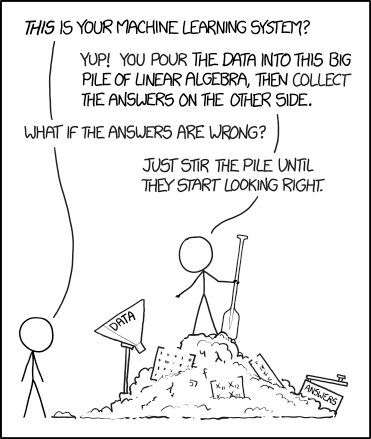
In a nutshell, AI works by tossing all human knowledge into a pile of linear algebra and mixing it up7. Then, answers pop out when you push questions in. But its training data is earthy knowledge. Job tells us that true wisdom, true divine wisdom, is not found on earth. It’s only with God. As Paul asks in first Corinthians,
Where is the one who is wise? Where is the scribe? Where is the debater of this age? Has not God made foolish the wisdom of the world? For since, in the wisdom of God, the world did not know God through wisdom, it pleased God through the folly of what we preach to save those who believe. For Jews demand signs and Greeks seek wisdom, but we preach Christ crucified, a stumbling block to Jews and folly to Gentiles, but to those who are called, both Jews and Greeks, Christ the power of God and the wisdom of God. For the foolishness of God is wiser than men, and the weakness of God is stronger than men.8
Ultimately God’s plan for the world seems foolish to us. He sent his son to die. What sense does that make? But Christians ought to place their hope and trust in the wisdom of God, which transcends and confounds the most advanced earthly intelligences, human or otherwise.
Footnotes
-
https://en.wikiquote.org/wiki/Alfred_Nobel. I admit this isn’t the most rigorous source. ↩
-
Decrease in Global Poverty, Increased Life Expectancy, just to name a few. ↩
-
ESV ↩
-
Power over creation, not power to dominate, but power to proclaim God’s name and to make beautiful works that bring him glory. ↩
-
GPT-3.5 and GPT-4 results are from GPT-4’s technical report. For the AP tests, the number represents score out of five. Higher is better. I admit that I’m cherry-picking a little bit here, but in the report (pg 5), you can see that the scores trend upward between the two models in almost all cases (i.e. both models scored the 2 on AP English Language/Literature and Composition). ↩
-
1 Corinthians 1:22-25 ↩